Photo Mosaicking of Low-Contrast Underwater Images
Oct 5, 2024
·
2 min read
This project implements a full photo mosaicking and optimization pipeline using low-contrast underwater images from the Skerki Bank Roman shipwreck dataset. The approach registers both sequential and non-sequential images using SIFT and RANSAC, computes affine transformations, and optimizes a global trajectory using GTSAM.
Pipeline Breakdown
CLAHE Image Enhancement
- Applies histogram equalization to improve contrast and enhance keypoints.
- OpenCV CLAHE was used on each grayscale frame.
clahe = cv2.createCLAHE(clipLimit=2.0, tileGridSize=(8, 8))
clahe_image = clahe.apply(gray_image)
SIFT Feature Detection
- Detected keypoints using tuned SIFT settings:
nfeatures=5000,contrastThreshold=0.025,nOctaveLayers=8,sigma=1.5
sift = cv2.SIFT_create(...)
kp, desc = sift.detectAndCompute(image, None)
Feature Matching + RANSAC Filtering
- Matched descriptors using Brute-Force Matcher + Lowe’s ratio test.
- Applied
cv2.estimateAffine2Dwith RANSAC to compute and refine transformation.
matches = bf.knnMatch(des1, des2, k=2)
good = [m for m, n in matches if m.distance < 0.75 * n.distance]
H, mask = cv2.estimateAffine2D(pts1, pts2, method=cv2.RANSAC)
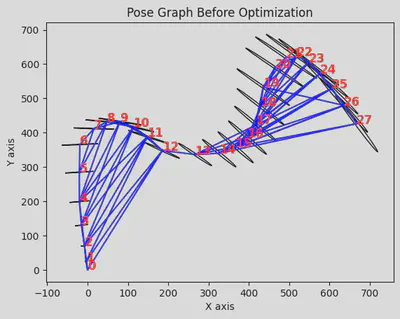
Pose Graph Construction (GTSAM)
- Built a factor graph using all non-repeating image pairs.
- Relative poses (affine transforms) were added as edges.
graph.add(BetweenFactorPose2(i1, i2, T_ij, noise_model))
Global Bundle Adjustment
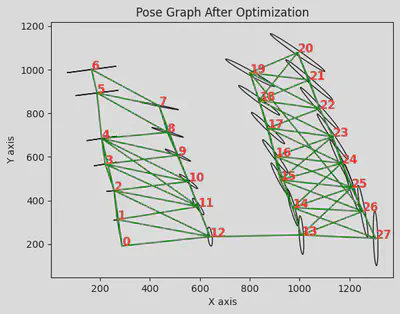
- Used GTSAM’s Levenberg-Marquardt optimizer to refine global poses.
- Corrects drift and adjusts poses to minimize total residual error.
optimizer = gtsam.LevenbergMarquardtOptimizer(graph, initial_estimate)
result = optimizer.optimize()
Techniques Used
- Image normalization + CLAHE
- SIFT feature detection and matching
- RANSAC for outlier rejection
- Homography estimation using Levenberg–Marquardt
- Graph construction (GTSAM)
- Loop closure detection
- Pose optimization
Results
- Successfully registered both sequential and non-sequential image pairs
- Constructed optimized pose graphs for 6 and 29 image subsets
- Achieved a ~20% improvement in alignment after bundle adjustment
📁 Related Files
References
- Pizarro & Singh (2003): Toward large-area mosaicing for underwater scientific applications.
- Ballard et al. (1998, 2000): Roman shipwreck discovery using submersible tech.