Sparse 3D Reconstruction and Bundle Adjustment
Nov 7, 2024
·
2 min read
This project implements a full Structure from Motion (SfM) pipeline on a Buddha statue using a sequence of 24 grayscale images. It combines feature detection, epipolar geometry, camera pose recovery, triangulation, and bundle adjustment.
Dataset
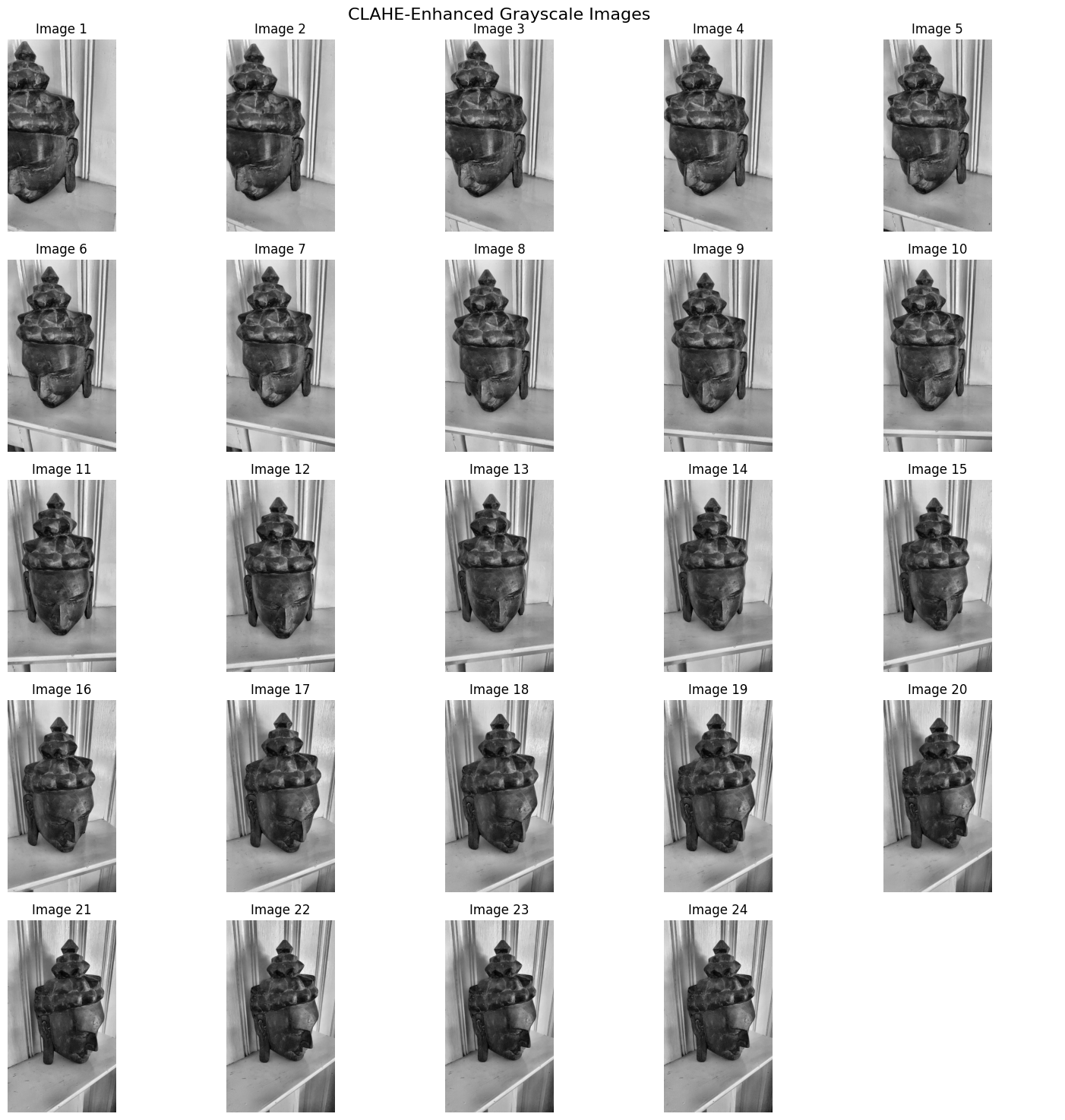
- 24 images of a wooden Buddha statue captured at different angles
- Enhanced using CLAHE (Contrast Limited Adaptive Histogram Equalization)
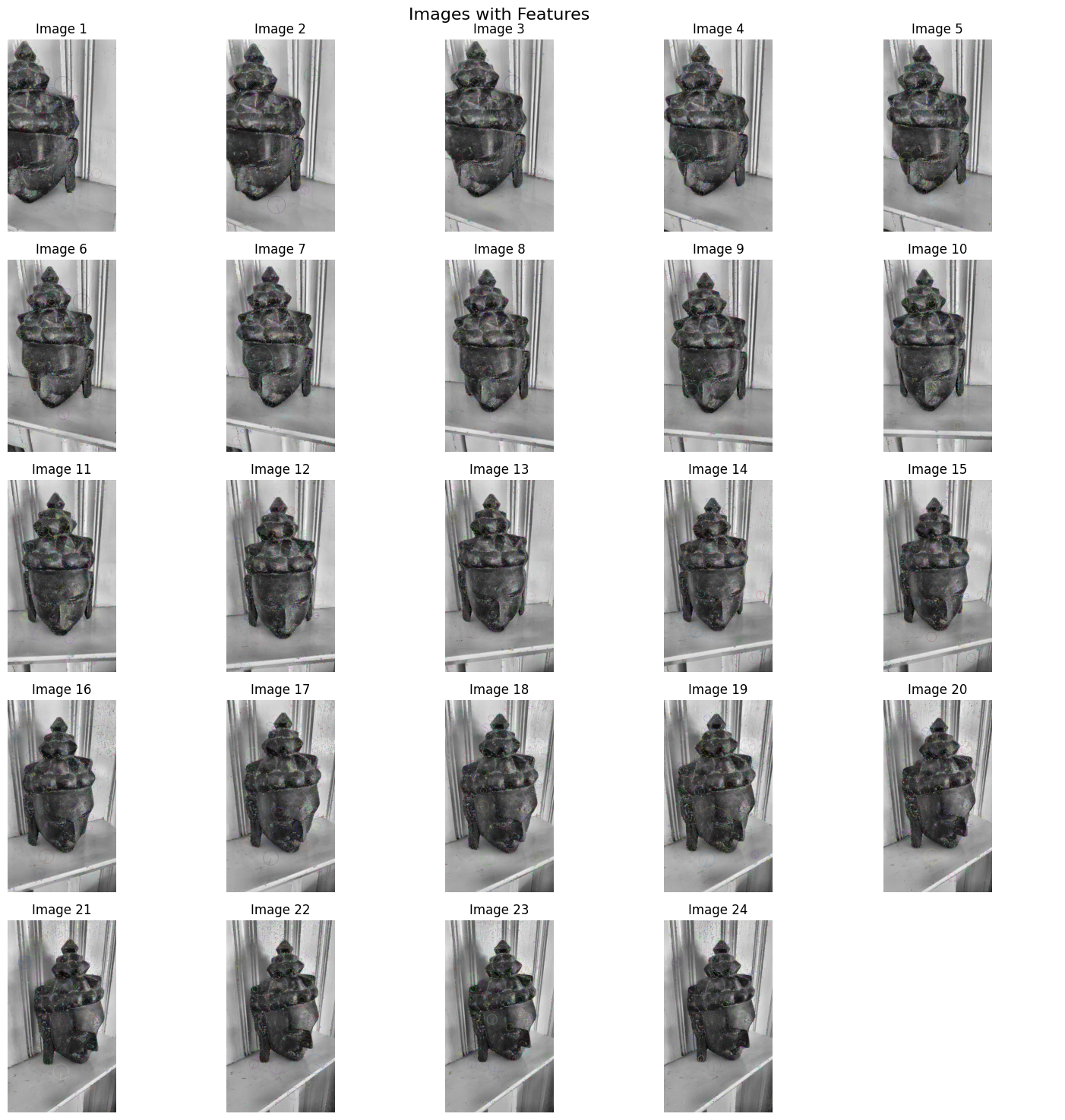
- Features extracted using SIFT with custom parameters
Pipeline Overview
1. Image Preprocessing
Using CLAHE improves contrast on low-texture surfaces like carved wood.
2. SIFT Feature Detection
- Applied to all 24 images
- Used BFMatcher with ratio test
- Matches filtered via RANSAC for outlier rejection
3. Essential Matrix & Pose Recovery
- Computed Essential matrix using calibrated camera matrix
- Used
cv2.recoverPose()to derive relative rotation and translation between views - Built a chain of camera poses from image 0 onward
4. Triangulation
- 3D points computed from pixel correspondences using
cv2.triangulatePoints() - All 3D points stored in homogeneous form
- Colored and visualized using Plotly
5. Bundle Adjustment with GTSAM
- Built a factor graph with:
- Camera pose priors
- Between factors from pose transitions
- Projection factors from 2D-3D matches
- Used
Levenberg-MarquardtOptimizerfor refinement
Results
Initial 3D Trajectory
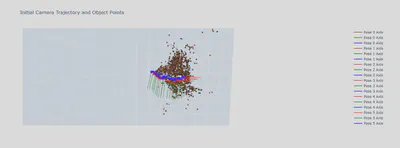
Optimized 3D Trajectory after Bundle Adjustment
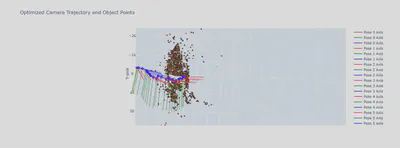
- Average reprojection error reduced by ~15%
- Landmark cloud tightened around object geometry
- Rotation drift corrected with global optimization
Tools & Libraries
- OpenCV (SIFT, RANSAC, triangulation)
- NumPy, Matplotlib, Plotly
- GTSAM (factor graph + BA)
- Python
Resources
This project demonstrates a scalable pipeline for SfM using minimal dependencies. It serves as a foundation for integrating real-time VIO or stereo SLAM on embedded platforms.